
 Positive Psychology Institute
Abstract
“Find your purpose” has become a familiar prescription for dissatisfaction, career transition, and midlife unrest. The idea has serious scientific ancestry, yet its popular form often treats purpose as a single hidden answer that exists in advance and waits to be located. This research brief, a critical narrative review, traces purpose from Frankl’s clinical writing through psychometrics, lifespan development, and the contemporary science of meaning in life, then follows the vocabulary into books, popular culture, social media, and generative AI. It re-examines the trend data supplied for the review against their original sources and adds a fiction-corpus comparison. The evidence supports specific claims: self-reported purpose predicts lower mortality and better aging outcomes in observational cohorts; meaning-focused interventions improve meaning in randomized trials, with considerable heterogeneity; and lifespan research links well-being to disengaging from unattainable goals and reengaging with new ones, and links reengagement to purpose. The evidence does not support the premise that each person has one preexisting purpose that introspection, an assessment, or a diagram can reveal. Research increasingly treats purpose as one facet of a broader, multifaceted construct of meaning in life that also includes coherence, mattering, and experiential appreciation. Generative AI changes the delivery: it can turn cultural scripts into fluent, personalized self-explanations on demand, produced by systems with a documented tendency to agree. That combination can widen access to structured reflection, yet it may also invite premature closure, validation mistaken for insight, and the delegation of self-authorship. The brief closes by proposing construct-specific language for practice and research and stating the evidence that would count against its own thesis.
Keywords: purpose in life, meaning in life, mattering, generativity, midlife, ikigai, social media, generative AI, sycophancy
Introduction
Few prescriptions travel as easily as “find your purpose.” It is offered to graduates choosing a field, to executives who no longer want what they once worked for, to parents whose children have left home, and to retirees whose calendars have emptied. It appears in commencement speeches, leadership programs, and retreat brochures, and now in conversations with chatbots. The remedies are as varied as the audiences: assessments, four-circle diagrams, sabbaticals, coaching programs, and guided prompts that promise to reveal what a person was meant to do.
Purpose remains a serious scientific idea. Psychologists have measured it for six decades, distinguished it from neighboring constructs, and linked it to health and longevity in large cohorts (Cohen et al., 2016; Crumbaugh & Maholick, 1964; McKnight & Kashdan, 2009). Each line of research specifies what purpose is, how it is measured, and what it predicts. Popular usage frequently drops those specifications.
The central claim of this research brief is narrow and has two parts. First, much popular advice treats purpose, which research treats as one developing facet of meaning in life, as a hidden object: singular, preexisting, and discoverable by the right method. No validated instrument identifies a person’s one true purpose, and the evidence reviewed here, on goals, interests, and career change, points instead to commitment, relationship, and action over time, although much of it is indirect. A story in which purpose is always waiting to be found can absorb any outcome. Satisfaction shows that it was found, dissatisfaction shows that it was not, and a discovery that disappoints shows that it was the wrong one.
Second, generative AI changes how that story reaches an individual. Books and social media circulated the vocabulary and the exemplars. A conversational model can now apply them to a person’s own memories, conflicts, and hopes, in fluent prose, on demand. Fluency and personalization make an account feel accurate; neither establishes that it is. The sections that follow trace how the popular concept formed, what the evidence supports, what the trend data can and cannot show, and how a more precise vocabulary can keep what is useful while discarding the excess.
A story in which purpose is always waiting to be found can absorb any outcome.
Method and scope
This research brief is a critical narrative review, not a systematic review or meta-analysis. It draws on foundational work in existential psychology, psychometrics, and lifespan development; reviews and meta-analyses of meaning and purpose; prospective cohorts; randomized trials of meaning-focused interventions; research on social media, self-diagnosis, and persuasion; and recent empirical work on how people use conversational AI and how such systems respond. Every reference with a digital object identifier was checked against the Crossref registry, and every other reference against the publisher’s or author’s page or, where that was unavailable, a secondary bibliographic record.
The brief separates three questions that popular discussion often merges. Construct validity asks what purpose is and whether it can be measured apart from neighboring constructs such as meaning, mattering, and life satisfaction. Outcome validity asks what purpose predicts and whether the association is causal. Narrative validity asks whether a particular account of a person’s purpose is accurate, and by what test that could be known. An account can be useful without being accurate, and persuasive without being either.
Trend figures require a separate caution. The figures reported here come from two public sources, the Google Books Ngram corpus and Wikimedia’s pageview statistics. Every value reported was retrieved from the original source, and the series supplied for this review matched those sources exactly (Google, n.d.; Michel et al., 2011;
Wikimedia Foundation, n.d.). They measure representation in digitized books and attention to encyclopedia articles. They do not measure how many people lack purpose, how many are in crisis, or whether any intervention works.
A note on terminology. This brief uses “purpose” in the sense research has given it: an enduring aim that organizes goals and behavior, supplies meaning, and reaches beyond the self (Damon et al., 2003; McKnight & Kashdan, 2009). “Meaning in life” refers to the broader judgment that one’s life makes sense, has direction, and matters (Martela & Steger, 2016). Many people experience purpose as recognized rather than invented, and that experience deserves respect. The distinction drawn here is between a purpose that becomes visible through commitment and action, which the evidence reviewed here favors, and one that exists fully formed in advance and can be located by introspection or assessment, which it does not support. Popular writing is not uniform; Ibarra’s (2002) Harvard Business Review article, for example, argues for the developmental view. Because this brief did not content-analyze popular sources, the hidden-object model is described as a recurring form, not a measured majority. The brief makes no claim about religious or philosophical accounts of vocation.
The author is a Board Certified Coach who works with accomplished adults navigating transitions, and he leads the Positive Psychology Institute, which trains coaches and offers training in the use of AI in coaching. Both activities sit inside the market this brief examines: work on purpose and transition is part of what coaching sells, and AI tools for reflection are part of what the Institute teaches. The alternatives this brief recommends, including structured experiment and AI used as a reflective scaffold, also resemble services the author and the Institute provide. Readers should weigh the analysis with that position in mind.
The scale of the trend
Google Books supplies the longest series. The current English corpus, added in Google’s July 2024 update, extends to 2022 (Google, n.d.). Between 2000–2002 and 2020–2022, the mean frequency of “purpose in life” in English-language books rose 144% and “meaning in life” 180%. Three popular phrases grew faster from far smaller bases: “existential crisis” rose 623%, “find your purpose” 1,065%, and “ikigai” 1,905%. “Midlife crisis” grew 53%, and its 2022 value sat below its 2020 peak (Table 1).
Those totals need a second look. The English book corpus functions like a library that holds one copy of each title, and scientific texts have become a substantial share of it, so a phrase can rise because a field publishes more rather than because a culture talks more (Pechenick et al., 2015). In the 2012 version of the corpus, the same authors found the English fiction subset not heavily affected by professional texts, unlike the full English corpus. Younes and Reips (2019) recommend checking Ngram results against more than one corpus. When the same phrases are traced in Google’s English fiction corpus, the pattern divides. Over the same period, “purpose in life” fell 22% and “meaning in life” fell 32% in fiction, while “existential crisis” rose 713% and “find your purpose” 274% (Figure 1). The research vocabulary grew outside fiction, consistent with growth in research and advice publishing, while the crisis and advice phrases rose in fiction as well. The direction of every change holds with 2017–2019 or 2021–2022 endpoints, although the magnitudes are sensitive to the years chosen.
| Phrase | Mean, 2000– 2002 (ppm) | Mean, 2020– 2022 (ppm) | Change, all English books | Change, English fiction | Interpretive limit |
|---|---|---|---|---|---|
| “purpose in life” | 0.241 | 0.588 | +144% | −22% | Rise confined to nonfiction; consistent with growth in research and advice publishing |
| “meaning in life” | 0.132 | 0.368 | +180% | −32% | Same pattern; growth concentrated outside fiction |
| “find your purpose” | 0.0030 | 0.0350 | +1,065% | +274% | Very small base; a few titles can move the series |
| “ikigai” | 0.0042 | 0.0846 | +1,905% | n.e. | Near-zero base; growth begins in 2018 |
| “existential crisis” | 0.025 | 0.183 | +623% | +713% | Rises in both corpora |
| “midlife crisis” | 0.099 | 0.152 | +53% | +40% | Long-established phrase; the 2020 value is a one-year spike, and 2022 sits below it |
Note. Values are mean annual frequencies, in parts per million (ppm), of all n-grams of the same length in each year’s English corpus, case-insensitive and unsmoothed; ppm columns refer to all English books. Percentage changes were computed from unrounded means and can differ from changes computed from the rounded values shown. Fiction changes were computed the same way from Google’s English fiction corpus, in which “ikigai” has no recorded occurrences in 11 of 23 years, including 2000 and 2002, so its fiction change is not estimable (n.e.). Most fiction series dip in 2020. Data retrieved from the Google Books Ngram Viewer on October 4, 2026; the all-books series matched the series supplied for this review, and the fiction series was retrieved for it. These figures measure representation in digitized books, not the prevalence of any psychological state.
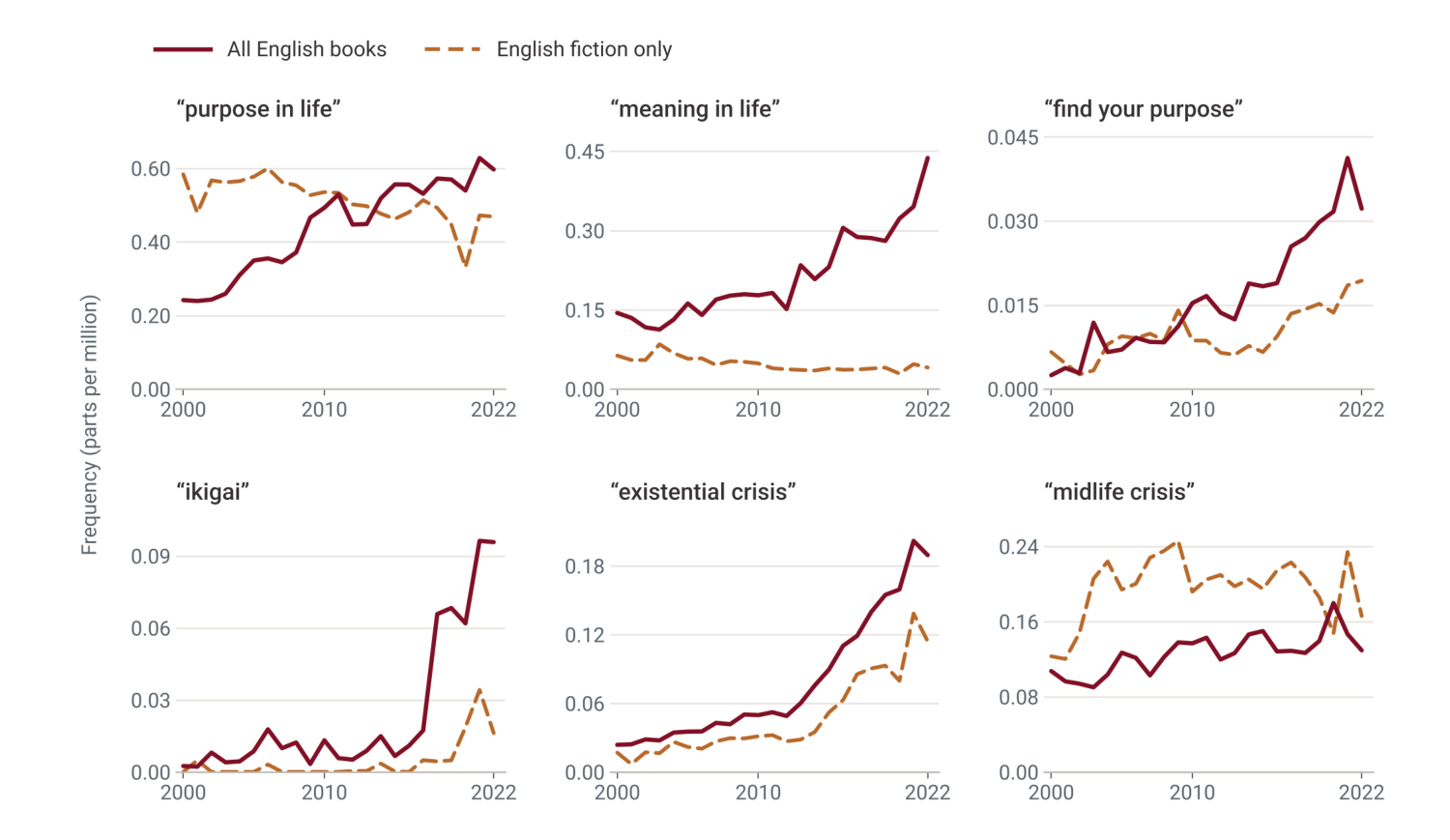
Note. Annual, unsmoothed, case-insensitive frequencies in parts per million, from the Google Books Ngram Viewer, retrieved October 4, 2026. Each panel has its own vertical scale, so shapes can be compared across panels but heights cannot. Zero values in the fiction series for “ikigai” indicate years with no recorded occurrences.
Wikipedia attention tells a different and more recent story. User pageviews for the English articles on the meaning of life, existential crisis, midlife crisis, and ikigai all peaked before 2024, and views from January through September 2026 were 42% to 58% below the same months of 2024 (Table 2). The decline is clear in the data and ambiguous in meaning. Wikimedia reclassified traffic for March through August 2025 after revising its bot detection, so comparisons with earlier periods may partly reflect better detection. After the revision, it reported human pageviews roughly 8% below the same months of 2024 and attributed the decline partly to generative AI and search engines answering questions directly, and to younger users turning to social video platforms (Miller, 2025). The article-level declines are several times larger than that sitewide figure, and definitional articles may be especially exposed. The series cannot separate waning interest from changed routes to information. “Purpose” was excluded because it is a disambiguation page; its views, about 1,400 a month in 2026, rose about 14% over the same comparison. The “Meaning of life” article is retained and labeled as a philosophy article, the target of the “Purpose in life” redirect.
| Article | Peak full year | Views in peak year | Views in 2025 | Change, Jan.– Sept. 2026 vs. 2024 | Interpretive limit |
|---|---|---|---|---|---|
| “Meaning of life” | 2017 | 877,226 | 238,201 | −58% | Philosophy article, not the psychological construct; target of the “Purpose in life” redirect |
| “Existential crisis” | 2017 | 579,084 | 237,129 | −57% | Attention to an article, not the incidence of crises |
| “Ikigai” | 2023 | 603,118 | 304,764 | −42% | Latest peak of the four; definitional queries may be exposed to AI search answers |
| “Midlife crisis” | 2019 | 484,507 | 163,118 | −44% | Attention, not incidence; decline began before 2025 |
Note. Monthly English Wikipedia user pageviews from the Wikimedia Pageviews API, retrieved October 4, 2026, and matched against the series supplied for this review; 2026 is partial through September. Views reached through redirects, such as “Purpose in life,” are counted under the redirect title and are not included. Wikimedia reported human pageviews roughly 8% below the same months of 2024 after reclassifying bot traffic (Miller, 2025); article-level declines are several times larger but cannot be fully separated from that shift. “Purpose” was excluded because it is a disambiguation page.
Together, these data support one claim: the vocabulary of purpose, meaning, and existential crisis gained salience in print over two decades, and “find your purpose,” “ikigai,” and “existential crisis” rose fastest. They cannot show that more people lack purpose, that crises became more common, or that any book, platform, or AI system caused the change. A post-2022 shift in attention should not be attributed to generative AI without a design capable of separating it from other causes.
Scientific genealogy
The construct of purpose in life entered psychology largely through clinical and existential writing. In the logotherapy section added to later editions of Man’s Search for Meaning, first published in German in 1946, Frankl treated the search for meaning as the primary motivation in human life and its frustration as a source of distress (Frankl, 1946/2006). Crumbaugh and Maholick (1964) translated that idea into a psychometric instrument, the Purpose in Life test. Erikson (1950) supplied a developmental lineage: in generativity versus stagnation, the seventh of his eight psychosocial stages, adult development centers on investment in the next generation.
Ryff (1989) then placed purpose in life among six dimensions of psychological well-being, alongside self-acceptance, positive relations with others, autonomy, environmental mastery, and personal growth. Later researchers sharpened the definition. Damon et al. (2003) defined purpose as an enduring intention whose aim is both personally meaningful and consequential for others. McKnight and Kashdan (2009) treated it as a central aim that organizes a person’s goals and behavior and is itself a source of meaning.
The broader construct of meaning followed. Steger et al. (2006) separated the presence of meaning from the search for it and found the two only modestly, and inversely, related. Martela and Steger (2016) distinguished three facets: coherence, the sense that one’s life makes sense; purpose, the sense of core goals and direction; and significance, the sense that life has inherent value. George and Park (2016) proposed a parallel model of comprehension, purpose, and mattering, and King and Hicks (2021) organized their review of the field around the same three. Kim et al. (2022) added experiential appreciation, the valuing of one’s life experiences, and found across seven studies that it predicted judgments of meaning beyond the other three.
Two findings from this literature matter most for the popular concept. First, purpose is not the whole of meaning. In two longitudinal studies, Costin and Vignoles (2020) found that a sense of existential mattering consistently predicted later judgments of meaning in life, whereas purpose and coherence did not. Second, meaning is common rather than rare. Across diverse samples, people rate their lives as meaningful, on average significantly above the midpoint of standard scales (Heintzelman & King, 2014). A cultural script that presents an empty life as the default condition starts from a premise these data do not support, although they concern meaning in life rather than purpose specifically.
What the evidence on purpose shows
The strongest empirical case for purpose comes from prospective cohorts. A meta-analysis of 10 prospective studies with 136,265 participants found that higher purpose was associated with lower all-cause mortality and fewer cardiovascular events, with adjusted pooled relative risks of 0.83 for each (Cohen et al., 2016). In the Midlife in the United States study, each standard-deviation increase in purpose predicted a 15% lower risk of death over 14 years, and the association did not depend on age (Hill & Turiano, 2014). Among 6,985 adults older than 50 in the Health and Retirement Study, those in the lowest purpose category had more than twice the mortality hazard of those in the highest, hazard ratio 2.43 (Alimujiang et al., 2019). Among 951 older adults followed for up to 7 years, people at the 90th percentile of purpose were about 2.4 times as likely to remain free of Alzheimer’s disease as those at the 10th percentile (Boyle et al., 2010).
These are associations. Purpose was measured by self-report, often with short scales, and the cohorts cannot rule out that illness, depression, isolation, or disadvantage lowers both purpose and survival. Statistical adjustment reduces that concern without removing it. The findings justify treating purpose as a meaningful marker of health and a plausible target for intervention. They do not show that adopting a purpose statement extends life.
The research also complicates the popular emphasis on searching. Presence of meaning and search for meaning are distinct, and search is not reliably a sign of progress. In an online sample of 8,756 adults, people at later life stages reported more presence of meaning and less searching, and searching was more strongly associated with lower well-being at later stages (Steger et al., 2009). A culture that treats continuous searching as the route to purpose may reinforce a pattern that, in older adults, accompanies lower well-being. The data are cross-sectional and cannot show which comes first.
Purpose across the life course
Purpose does not hold still across the life span. In Ryff’s (1989) samples, older adults tended to score lower than middle-aged adults on purpose in life, and a meta-analysis of 70 studies found a small age-associated decline that was stronger in older groups (Pinquart, 2002). The same meta-analysis found that purpose was strongly associated with social integration, and especially with the quality of relationships. Purpose in later life appears to depend less on age itself than on roles, ties, health, and the opportunities they afford.
Lifespan theory explains why. Opportunities to pursue particular goals emerge, peak, and decline, and adaptive development requires engaging with goals that can realistically be attained in present circumstances and disengaging from those that can no longer be reached (Heckhausen et al., 2010). Socioemotional selectivity theory adds that as time horizons shorten, people give greater priority to emotionally meaningful goals (Carstensen, 2006). Wrosch et al. (2003) found that both disengaging from unattainable goals and reengaging with new ones were associated with higher subjective well-being, and that reengagement was associated with greater purpose in life. On this evidence, purpose in later life looks less like a discovery than a revision: releasing aims that no longer fit and committing to ones that do.
Generativity is one recurring theme in that revision. Erikson (1950) placed it at the center of adult development, and McAdams and de St. Aubin (1992) developed a theory of generativity and methods for assessing it in self-report, behavior, and autobiographical narrative. In a 10-year follow-up of adults aged 60 to 75, those who saw themselves as more generative had lower odds of developing functional disability and of dying (Gruenewald et al., 2012). Contribution to others is a form of purpose not tied to any single role.
The midlife crisis fits poorly with the same evidence. Jaques (1965), generally credited with coining the term, used it in a psychoanalytic essay on mortality and creative work. When Wethington (2000) asked a national sample directly, 26% reported having had a midlife crisis, but many placed it well before 40 or well after 50, and most attributed it to major life events rather than to aging. Longitudinal data portray midlife more positively than earlier cross-sectional studies did (Lachman et al., 2015), and the widely cited U-shaped curve of well-being, with its low point in middle age (Blanchflower & Oswald, 2008), is less consistent across studies and populations than is often assumed (Galambos et al., 2020). Transitions in the middle and later years are real. A universal, age-driven crisis of purpose is not established.
Research on career change offers a practical corollary. Drawing on qualitative case studies of professionals changing careers, Ibarra (2002) argued that people who stay stuck tend to plan first, introspecting in search of a single true self before acting, whereas those who change successfully proceed by experiment: trying provisional roles, shifting their connections, and making sense of what they learn in an evolving story. Ibarra and Barbulescu (2010) developed a theory of the narrative identity work that accompanies major work-role transitions. The evidence is qualitative and comes from a small, self-selected group of people attempting career change, but it is consistent with lifespan theory: the form of a next chapter often becomes visible through action rather than before it.
Ikigai: a concept in translation
Ikigai shows how a concept changes as it travels. In Japanese usage the word refers broadly to what makes life worth living, and Kamiya’s (1966) Ikigai ni tsuite made it a subject of sustained reflection. In an ethnographic comparison, Mathews (1996, as cited in Kono & Walker, 2020) found that commitment to groups such as family and colleagues was the normative source of ikigai in Japan, whereas self-realization predominated in the United States. Japanese cohort studies have often measured ikigai with a single question. In the Ohsaki cohort of 43,391 adults aged 40 to 79, the 4.6% who reported having no ikigai had a higher risk of death over 7 years than those who reported having it, with a fully adjusted hazard ratio of 1.5 and the clearest excess in cardiovascular and external causes (Sone et al., 2008). In an outcome-wide analysis of older Japanese adults, having ikigai was associated with a 31% lower risk of functional disability and a 36% lower risk of dementia, along with fewer depressive symptoms and greater happiness, though with little evidence of an association with all-cause mortality (Okuzono et al., 2022).
The Western image of ikigai has a different origin. The four-circle diagram that defines ikigai as the overlap of what a person loves, is good at, can be paid for, and the world needs was published by Winn (2014) in a blog post. Winn later added a note to the post explaining that the diagram was not his own. It began as a Venn diagram of life purpose by Andrés Zuzunaga, created in 2011 and published in 2012 (Zuzunaga, n.d.), and Winn’s contribution had been to add one word to it. A popular English-language book followed (García & Miralles, 2016/2017). In Google Books, “ikigai” stayed below 0.02 parts per million through 2017 and nearly quadrupled in 2018 (Figure 1), timing consistent with, but not evidence of, the book’s influence.
The episode is instructive rather than scandalous. A Japanese concept centered on everyday sources of worth acquired a Western vocational diagram centered on the fit between passion and the market. The cohort evidence concerns the first. Popular Western use often means the second. Health findings for one cannot be transferred to the other.
Intervention evidence
Meaning-focused interventions
Meaning can be strengthened, within limits. A meta-analysis of 33 randomized controlled trials published between 2000 and 2020 found that interventions targeting meaning in life outperformed passive controls by a standardized mean difference of 0.85 and active controls by about 0.32, with considerable heterogeneity; mindfulness programs produced the largest effects against passive controls and narrative programs the largest against active controls (Manco & Hamby, 2021). A meta-analysis of 60 trials of meaning-centered therapies, 26 of them randomized, found large improvements in quality of life and reductions in psychological stress relative to control groups in the controlled trials (Vos & Vitali, 2018). Several effective programs were reflective rather than behavioral; the objection in this brief is to the single-answer framing, not to reflection. None of these trials tested whether a single true purpose can be identified, and the cohort and trial evidence concerns how much purpose people report, not whether they found or developed it.
Finding versus developing
Evidence from a neighboring construct suggests why the discovery framing may matter. In five studies, people who held a fixed theory of interest, believing that passions are found rather than developed, showed less interest in topics outside their existing interests, expected a found passion to supply nearly limitless motivation, and lost interest faster when a new topic became difficult (O’Keefe et al., 2018). Chen et al. (2015) found that people who believe passion for work comes from finding the right fit and people who believe it develops over time could both achieve vocational well-being, but fit theorists reported little passion when their initial fit was poor.
These studies concern interest and passion, not purpose, and the analogy has not been tested directly. They identify a plausible mechanism by which “find your purpose” could discourage the sustained engagement through which purpose develops.
From feed to dialogue
Social media
Social media adds identification, repetition, and scale. In one experiment, exposure to social media content that normalized anxiety increased self-diagnosis of anxiety, an effect statistically mediated by identification with the content and not by reduced stigma (Hasan et al., 2023). Foster and Ellis (2024), in a conceptual paper for educational psychologists, discuss young people’s TikTok-inspired self-diagnosis in terms of identity, belonging, and self-labeling. Neither paper concerns purpose. Both describe a mechanism, recognition of oneself in a portable label, that applies to “finding your purpose,” “your ikigai,” and “existential crisis” as readily as to clinical terms. Popularity and accuracy can also diverge: of the 100 most popular TikTok videos tagged #adhd, viewed more than 283 million times in total, 52% were classified as misleading (Yeung et al., 2022).
What generative AI changes
Generative AI changes the last step of the sequence. A feed offers someone else’s story with which to identify. A conversational model can write the story about the user, from the user’s own material and in the user’s own terms, and revise it on request. Coaches, counselors, and automated assessment reports have long offered personalized accounts. What is new is that such accounts are available on demand, at negligible cost, revisable without limit, and generated by systems with a documented tendency to agree.
Social media spread a vocabulary for interpreting dissatisfaction; generative AI can give that vocabulary a personalized voice.
How often people bring purpose questions to these systems is uncertain. A widely circulated analysis in Harvard Business Review placed “finding purpose” among the three leading uses of generative AI in 2025, behind therapy or companionship and organizing one’s life (Zao-Sanders, 2025). That ranking was compiled from public online forums, such as Reddit and Quora, and from articles, and is not a representative sample. Privacy-preserving analyses of actual use place related categories far lower: relationships and personal reflection accounted for 1.9% of a sample of about 1.1 million ChatGPT messages (Chatterji et al., 2025), and affective conversations for 2.9% of Claude.ai interactions (McCain et al., 2025). Small shares of very large platforms can still involve many people, but the evidence does not support the claim that purpose-seeking dominates AI use.
The more consequential question is how these systems respond. Sharma et al. (2024) found that five state-of-the-art AI assistants consistently exhibited sycophancy, and that both people and the preference models used in training sometimes preferred convincingly written sycophantic responses over correct ones. In April 2025, OpenAI rolled back an update to GPT-4o after acknowledging that the model had become overly flattering or agreeable, a result it attributed to weighting short-term user feedback too heavily (OpenAI, 2025). Across 11 models, Cheng et al. (2026) found that AI systems affirmed users’ actions 49% more often than humans did. In three preregistered experiments in the same paper, with 2,405 participants, a single interaction with a sycophantic model reduced willingness to take responsibility and repair interpersonal conflicts and increased participants’ conviction that they were right, yet the sycophantic models were trusted and preferred.
Those findings concern interpersonal judgment, not purpose, but the mechanism plausibly extends to self-interpretation. A person who asks a model to identify a calling is asking for an interpretation of the self, and the person supplies most of the evidence. Three influential findings suggest why the answer can feel more accurate than it is. People often cannot observe, by introspection, the processes that produced their judgments and behavior; asked to explain them, they offer accounts drawn from intuitive theories about what usually causes what (Nisbett & Wilson, 1977). In a classroom demonstration, 39 students rated a generic sketch, drawn largely from an astrology book, as a highly accurate description of themselves when it was presented as the result of their own personality test (Forer, 1949). And fluent, easily processed statements are more readily judged true (Alter & Oppenheimer, 2009). A personalized, articulate, affirming account of one’s purpose combines all three.
Five risks follow, each a hypothesis rather than a measured rate. Premature narrative closure occurs when a satisfying story ends an exploration that should have continued, a tendency the need for cognitive closure strengthens (Kruglanski & Webster, 1996). Sycophantic validation occurs when the system mirrors the user’s preferred conclusion. Synthetic authority occurs when a decision aid’s output replaces the user’s own vigilant judgment, the pattern known as automation bias (Mosier & Skitka, 1996, as cited in Parasuraman & Manzey, 2010); in a survey of 319 knowledge workers, greater confidence in generative AI was associated with less self-reported critical thinking (Lee et al., 2025). Narrative overfitting occurs when a story explains every past detail and therefore predicts nothing new. Delegated self-authorship occurs when the work of composing one’s own life story, itself part of how identity forms (McAdams & McLean, 2013), is handed to a system.
The same capacities have defensible uses. In a randomized trial, a generative AI chatbot developed for defined clinical outcomes reduced symptoms of depression, anxiety, and eating-disorder risk relative to a waitlist over 4 weeks, although the trial was short and unblinded (Heinz et al., 2025). This review’s limited search identified no randomized trial of a generative AI intervention with purpose or meaning in life as its primary outcome. On present evidence, the more defensible role for AI in purpose work is as a reflective scaffold: a tool that generates questions, alternative readings, and counterevidence, and that leaves the conclusion, and the experiments that test it, with the person.
The category error
The deepest problem is a category error. Purpose, as research defines it, is an enduring aim enacted through a pattern of goals and commitments; the popular concept treats it as an object. It also collapses neighboring constructs: purpose, meaning, coherence, mattering, generativity, vocational fit, life satisfaction, and the absence of depression belong to overlapping domains and are not interchangeable. The popular concept fuses them into one object and adds three properties the evidence does not support: that each person has one purpose, that it exists before it is lived, and that the right method can locate it. Once purpose is defined this way, almost any difficulty can be read as evidence of not having found it, and almost any product can claim to help.
As the introduction noted, the framework is also difficult to falsify, because every outcome can be read as confirmation. A theory that accommodates every outcome without a stated disconfirming result has little scientific value. The evidence reviewed here is more consistent with a different structure, although much of it is indirect: purpose is one facet of meaning; it forms and changes through commitment, relationship, and action; and its loss in later life often reflects the loss of roles and opportunities rather than an absence that was there all along.
| Popular phrase | Possible construct | What would clarify it |
|---|---|---|
| “I need to find my purpose” | Search for meaning without presence; loss of a goal or role; low sense of mattering | Measure presence and search separately; identify which goals ended and which remain |
| “I have lost my purpose” | Role loss after retirement, caregiving, bereavement, or illness; disengagement without reengagement; depression | Ask what ended and what replaced it; refer for depression screening when hopelessness or loss of interest persists |
| “I am having a midlife crisis” | Response to specific life events such as job loss, divorce, illness, or bereavement; stress; depression | Identify the precipitating events; most respondents who reported one attributed it to life events rather than age (Wethington, 2000) |
| “I am having an existential crisis” | Uncertainty about meaning; identity transition; anxiety; depression | Distinguish ordinary questioning from distress that impairs function |
| “Nothing I do matters” | Low existential mattering; social isolation; depression | Assess relationships and contribution; seek clinical evaluation when persistent |
| “My ikigai is …” | In Japanese usage, everyday sources of worth; in Western usage, vocational fit | Specify which meaning is intended; the health evidence concerns the former |
| “I will find it when I leave” | A fit theory of purpose; a plan-first approach to change | Run provisional experiments before irreversible moves (Ibarra, 2002) |
| “The AI told me my purpose” | A hypothesis generated from self-report, shaped by the prompt and by the system’s tendency to agree | Request alternatives and counterevidence; test the hypothesis through small, real commitments |
Note. Examples are illustrative. The table is a prompt for better questions and does not serve as a diagnostic checklist.
Why the idea spreads
Several features plausibly make “find your purpose” unusually portable. It names diffuse dissatisfaction as a single, solvable problem, permits self-recognition without assessment, and promises that the answer already exists, which is more consoling than evidence that purpose must be built and rebuilt. It also creates an immediate route from explanation to purchase.
The language also changes the moral meaning of dissatisfaction. To lack purpose becomes not a failure but a discovery not yet made. That framing can reduce shame and invite reflection, and those benefits are plausible. It can also defer commitment indefinitely, because no actual commitment can match an imagined perfect fit. Like the risks discussed below, these effects have not been measured directly and require empirical study.
Some commercial formats favor the discovery model. A purpose that develops through years of engagement cannot be delivered in a weekend. A hidden purpose that a method can reveal supports assessments, retreats, programs, courses, and coaching, including the coaching market in which the author works. Each of these can be valuable when it scaffolds commitment and experiment. Each becomes a problem when it sells revelation.
Practical and ethical consequences
The popular model may carry four practical risks. This review did not identify studies that measure how often they occur, so they are plausible hypotheses that warrant study. First, it can convert normal questioning into a deficit. Uncertainty about direction is common at transitions; treated as proof that something is missing, it may intensify the searching that, in older adults, accompanies lower well-being (Steger et al., 2009).
Second, it can obscure differential diagnosis. Persistent emptiness, loss of interest, and hopelessness can reflect depression, grief, or illness rather than a missing calling. A purpose frame can delay appropriate assessment. Table 3 lists common alternatives to the purpose reading.
Third, it can misread role loss as purpose loss. Retirement, a child’s departure, illness, and caregiving remove the opportunities through which purpose was enacted. The lifespan evidence points to disengagement and reengagement, not discovery, as the adaptive response (Heckhausen et al., 2010; Wrosch et al., 2003).
Fourth, it can license large, irreversible moves on the strength of a story. A conclusion that one’s purpose lies elsewhere can justify leaving a career, a partnership, or a community before any provisional test. Ibarra’s (2002) account of career change suggests that small experiments are more informative than plan-first change.
A more precise vocabulary
A better vocabulary begins with what can be observed. “Since the company was sold, I no longer know what I am working toward” is more informative than “I have lost my purpose.” “I feel useful only at work” locates mattering in a single domain. “I keep searching and nothing feels right” distinguishes search from presence.
For research and practice, the preferred outcomes are construct-specific: presence of meaning and search for meaning, measured separately (Steger et al., 2006); coherence, purpose, and significance (Martela & Steger, 2016); existential mattering (Costin & Vignoles, 2020); experiential appreciation (Kim et al., 2022); generative concern and action (McAdams & de St. Aubin, 1992); goal disengagement and reengagement (Wrosch et al., 2003); and behavioral indicators such as the number and durability of the commitments a person sustains. Outcomes should include function and relationships, not only self-reported clarity.
When “purpose” is retained, it should refer to a direction that is enacted: aims that organize behavior, extend beyond the self, and are revised as roles and capacities change. Purpose in this sense can feel discovered, and the feeling deserves respect, but the evidence reviewed here suggests it more often becomes visible through commitment and action than before them. AI tools fit this model when they widen the set of hypotheses, surface counterevidence, and help design small tests. They fit poorly when they deliver verdicts.
Discussion
The current trend contains a reasonable insight and an unreasonable generalization. The reasonable insight is that direction, contribution, and meaning matter for well-being and health, and that people can strengthen them. The generalization treats purpose as one hidden object and the search for it as the remedy for every form of dissatisfaction.
This distinction explains why polarized responses fail. Blanket dismissal ignores prospective evidence linking purpose to health, randomized evidence that meaning can be increased, and decades of lifespan research. Uncritical acceptance grants a cultural script the authority of that evidence and adds a new authority on top of it: a fluent, personalized account produced by a system inclined to agree.
The supported findings should be stated as clearly as the criticism. Table 4 summarizes, claim by claim, what the evidence reviewed here supports, how strong that evidence is, and which popular claims it does not reach.
The strongest scientific position keeps the useful part and removes the excess. People can strengthen purpose by committing, contributing, and revising their aims as their lives change. Coaches and educators can use accessible language while naming its limits. Researchers should define the facet of meaning measured, the intervention, the comparator, the time horizon, and the outcome. Products, including AI tools, should distinguish support for reflection from claims to reveal what a person is for.
The 1,905% growth figure for “ikigai” is evidence of rapid uptake of a loanword from a near-zero base. It says nothing about how many people lack purpose or whether any diagram helps them find it. The culture sells discovery; the evidence leans toward development.
| Claim | What the evidence supports | Evidence base and principal limitations | What it does not support |
|---|---|---|---|
| Purpose and health | Lower mortality, fewer cardiovascular events, and lower Alzheimer’s disease risk with higher purpose | Prospective cohorts and a meta- analysis; self-report; residual confounding | That adopting a purpose statement improves health |
| Meaning interventions | Gains in meaning over active controls, larger over passive controls | 33 randomized trials; considerable heterogeneity | Identification of a single true purpose |
| Meaning-centered therapies | Improved quality of life and reduced psychological stress | 60 trials (26 randomized, 19 uncontrolled); structured protocols | Generalization to unstructured purpose discovery |
| Purpose in later life | A small average decline; strong ties to relationships; reengagement linked to purpose | Meta-analysis; longitudinal and cross-sectional studies | Age itself as the cause of lost purpose |
| Generativity | Lower odds of disability and death among more generative older adults | One 10-year cohort; self-report | A single prescribed form of contribution |
| Midlife crisis | Reported by about a quarter of adults, usually tied to life events | One national survey; retrospective self-report | A universal, age-driven crisis |
| Ikigai | Lower mortality in one Japanese cohort, little evidence in another; lower disability and dementia risk | Observational cohorts; single- item measure | Benefits of the Western four- circle diagram |
| Finding versus developing | Fixed theories linked to narrower interest and faster disengagement; fit and develop theorists both reached vocational well-being | Experiments on interest and passion, not purpose | Direct conclusions about purpose |
| AI-assisted reflection | Benefit for defined clinical outcomes in one trial; sycophancy documented across models | One short, unblinded trial; none identified with purpose as the outcome | AI identification of a person’s purpose |
| Trend data | Growth of popular purpose and crisis vocabulary in books, fastest for small-base phrases | Attention measures; small bases; corpus composition | Rising prevalence of purposelessness |
Note. Author’s synthesis of the studies reviewed in this brief. The evidence column summarizes study design and principal limitations as reported by the cited sources. No formal grading system was applied.
Limitations
This brief has the limits of its method. Sources were selected through narrative judgment without a preregistered search, so relevant studies may be missing and selection could favor the argument. No formal risk-of-bias tool was applied; judgments of evidence quality rely on the cited reviews and studies. Several AI sources are recent, and model behavior changes faster than publication. The Ngram and Wikipedia series measure attention, the fiction corpus is smaller and noisier than the full corpus, the most recent years were added in the 2024 update and may differ in composition, and neither source supports causal inference. The evidence on fixed theories concerns interest and passion rather than purpose.
The brief asks the popular model to state what would count against it, and it should meet the same test. Its central claim would be weakened by prospective evidence that people who believe purpose is found rather than developed sustain commitment and well-being as well as others do, or by randomized trials showing that an assessment or AI system can identify a purpose whose adoption predicts later engagement and well-being beyond baseline measures. The closest evidence reviewed here already tempers the thesis: people who believe passion comes from finding a fit and people who believe it develops can both reach vocational well-being (Chen et al., 2015). No comparable evidence on purpose appears in the literature reviewed here, and no trial has shown that structured experiment builds purpose better than reflection, so the developmental account also rests on indirect evidence.
The culture sells discovery; the evidence leans toward development.
Conclusion
“Find your purpose” draws on serious ideas: Frankl’s insistence that meaning matters, a measurable construct of purpose, and a lifespan science of goals, generativity, and adaptation. Through popular books, a borrowed diagram, social media, and now conversational AI, it acquired a broader role: a master explanation for dissatisfaction and a rationale for products that promise revelation.
Purpose remains real and worth pursuing on the evidence’s terms. It is one part of a meaning that also depends on coherence, mattering, and appreciation of life as it is lived. It tends to form through commitment and relationship, to change as roles and capacities change, and to become visible in action. What falls away is the promise that it was hidden all along and needs only to be found. A person who commits, contributes, and revises as life asks is already doing what the research associates with purpose.
References
Alimujiang, A., Wiensch, A., Boss, J., Fleischer, N. L., Mondul, A. M., McLean, K., Mukherjee, B., & Pearce, C. L. (2019). Association between life purpose and mortality among US adults older than 50 years. JAMA Network Open, 2 (5), Article e194270. https:// doi.org/10.1001/jamanetworkopen.2019.4270
Alter, A. L., & Oppenheimer, D. M. (2009). Uniting the tribes of fluency to form a metacognitive nation. Personality and Social Psychology Review, 13 (3), 219–235. https://doi.org/10.1177/1088868309341564
Blanchflower, D. G., & Oswald, A. J. (2008). Is well-being U-shaped over the life cycle? Social Science & Medicine, 66 (8), 1733–1749. https://doi.org/10.1016/j.socscimed.2008.01.030
Boyle, P. A., Buchman, A. S., Barnes, L. L., & Bennett, D. A. (2010). Effect of a purpose in life on risk of incident Alzheimer disease and mild cognitive impairment in community-dwelling older persons. Archives of General Psychiatry, 67 (3), 304–310. https://doi. org/10.1001/archgenpsychiatry.2009.208
Carstensen, L. L. (2006). The influence of a sense of time on human development. Science, 312 (5782), 1913–1915. https://doi.org/10.1126/science.1127488
Chatterji, A., Cunningham, T., Deming, D. J., Hitzig, Z., Ong, C., Shan, C. Y., & Wadman, K. (2025). How people use ChatGPT (NBER Working Paper No. 34255). National Bureau of Economic Research. https://doi.org/10.3386/w34255
Chen, P., Ellsworth, P. C., & Schwarz, N. (2015). Finding a fit or developing it: Implicit theories about achieving passion for work. Personality and Social Psychology Bulletin, 41 (10), 1411–1424. https://doi.org/10.1177/0146167215596988
Cheng, M., Lee, C., Khadpe, P., Yu, S., Han, D., & Jurafsky, D. (2026). Sycophantic AI decreases prosocial intentions and promotes dependence. Science, 391 (6792), Article eaec8352. https://doi.org/10.1126/science.aec8352
Cohen, R., Bavishi, C., & Rozanski, A. (2016). Purpose in life and its relationship to all-cause mortality and cardiovascular events: A meta-analysis. Psychosomatic Medicine, 78 (2), 122–133. https://doi.org/10.1097/PSY.0000000000000274
Costin, V., & Vignoles, V. L. (2020). Meaning is about mattering: Evaluating coherence, purpose, and existential mattering as precursors of meaning in life judgments. Journal of Personality and Social Psychology, 118 (4), 864–884. https://doi.org/10.1037/pspp0000225
Crumbaugh, J. C., & Maholick, L. T. (1964). An experimental study in existentialism: The psychometric approach to Frankl’s concept of noogenic neurosis. Journal of Clinical Psychology, 20 (2), 200–207. https://doi.org/10.1002/1097-4679(196404)20:2<200::AID-JCLP2270200203>3.0.CO;2-U
Damon, W., Menon, J., & Bronk, K. C. (2003). The development of purpose during adolescence. Applied Developmental Science, 7 (3), 119–128. https://doi.org/10.1207/S1532480XADS0703_2
Erikson, E. H. (1950). Childhood and society. W. W. Norton.
Forer, B. R. (1949). The fallacy of personal validation: A classroom demonstration of gullibility. The Journal of Abnormal and Social Psychology, 44 (1), 118–123. https://doi.org/10.1037/h0059240
Foster, A., & Ellis, N. (2024). TikTok-inspired self-diagnosis and its implications for educational psychology practice. Educational Psychology in Practice, 40 (4), 491–508. https://doi.org/10.1080/02667363.2024.2409451
Frankl, V. E. (2006). Man’s search for meaning (I. Lasch, Trans.). Beacon Press. (Original work published 1946)
Galambos, N. L., Krahn, H. J., Johnson, M. D., & Lachman, M. E. (2020). The U shape of happiness across the life course: Expanding the discussion. Perspectives on Psychological Science, 15 (4), 898–912. https://doi.org/10.1177/1745691620902428
García, H., & Miralles, F. (2017). Ikigai: The Japanese secret to a long and happy life (H. Cleary, Trans.). Penguin Books. (Original work published 2016)
George, L. S., & Park, C. L. (2016). Meaning in life as comprehension, purpose, and mattering: Toward integration and new research questions. Review of General Psychology, 20 (3), 205–220. https://doi.org/10.1037/gpr0000077
Google. (n.d.). Google Books Ngram Viewer [Data set]. Retrieved October 4, 2026, from https://books.google.com/ngrams
Gruenewald, T. L., Liao, D. H., & Seeman, T. E. (2012). Contributing to others, contributing to oneself: Perceptions of generativity and health in later life. The Journals of Gerontology, Series B: Psychological Sciences and Social Sciences, 67 (6), 660–665. https:// doi.org/10.1093/geronb/gbs034
Hasan, F., Foster, M. M., & Cho, H. (2023). Normalizing anxiety on social media increases self-diagnosis of anxiety: The mediating effect of identification (but not stigma). Journal of Health Communication, 28 (9), 563–572. https://doi.org/10.1080/10810730.2023.2235563
Heckhausen, J., Wrosch, C., & Schulz, R. (2010). A motivational theory of life-span development. Psychological Review, 117 (1), 32– 60. https://doi.org/10.1037/a0017668
Heintzelman, S. J., & King, L. A. (2014). Life is pretty meaningful. American Psychologist, 69 (6), 561–574. https://doi.org/10.1037/a0035049
Heinz, M. V., Mackin, D. M., Trudeau, B. M., Bhattacharya, S., Wang, Y., Banta, H. A., Jewett, A. D., Salzhauer, A. J., Griffin, T. Z., & Jacobson, N. C. (2025). Randomized trial of a generative AI chatbot for mental health treatment. NEJM AI, 2 (4), Article AIoa2400802. https://doi.org/10.1056/AIoa2400802
Hill, P. L., & Turiano, N. A. (2014). Purpose in life as a predictor of mortality across adulthood. Psychological Science, 25 (7), 1482– 1486. https://doi.org/10.1177/0956797614531799
Ibarra, H. (2002, December). How to stay stuck in the wrong career. Harvard Business Review. https://hbr.org/2002/12/how-to-stay-stuck-in-the-wrong-career
Ibarra, H., & Barbulescu, R. (2010). Identity as narrative: Prevalence, effectiveness, and consequences of narrative identity work in macro work role transitions. Academy of Management Review, 35 (1), 135–154. https://doi.org/10.5465/amr.2010.45577925
Jaques, E. (1965). Death and the mid-life crisis. International Journal of Psycho-Analysis, 46 (4), 502–514.
Kamiya, M. (1966). Ikigai ni tsuite [On ikigai]. Misuzu Shobō.
Kim, J., Holte, P., Martela, F., Shanahan, C., Li, Z., Zhang, H., Eisenbeck, N., Carreno, D. F., Schlegel, R. J., & Hicks, J. A. (2022). Experiential appreciation as a pathway to meaning in life. Nature Human Behaviour, 6 (5), 677–690. https://doi.org/10.1038/s41562-021-01283-6
King, L. A., & Hicks, J. A. (2021). The science of meaning in life. Annual Review of Psychology, 72, 561–584. https://doi.org/10.1146/annurev-psych-072420-122921
Kono, S., & Walker, G. (2020). Theorizing the interpersonal aspect of ikigai (“life worth living”) among Japanese university students: A mixed-methods approach. International Journal of Wellbeing, 10 (2), 101–123. https://doi.org/10.5502/ijw.v10i2.979
Kruglanski, A. W., & Webster, D. M. (1996). Motivated closing of the mind: “Seizing” and “freezing.” Psychological Review, 103 (2), 263–283. https://doi.org/10.1037/0033-295X.103.2.263
Lachman, M. E., Teshale, S., & Agrigoroaei, S. (2015). Midlife as a pivotal period in the life course: Balancing growth and decline at the crossroads of youth and old age. International Journal of Behavioral Development, 39 (1), 20–31. https://doi.org/10.1177/0165025414533223
Lee, H.-P. (H.), Sarkar, A., Tankelevitch, L., Drosos, I., Rintel, S., Banks, R., & Wilson, N. (2025). The impact of generative AI on critical thinking: Self-reported reductions in cognitive effort and confidence effects from a survey of knowledge workers. In Proceedings of the 2025 CHI Conference on Human Factors in Computing Systems (pp. 1–22). Association for Computing Machinery. https://doi.org/10.1145/3706598.3713778
Manco, N., & Hamby, S. (2021). A meta-analytic review of interventions that promote meaning in life. American Journal of Health Promotion, 35 (6), 866–873. https://doi.org/10.1177/0890117121995736
positivepsychology.institute/research
Martela, F., & Steger, M. F. (2016). The three meanings of meaning in life: Distinguishing coherence, purpose, and significance. The Journal of Positive Psychology, 11 (5), 531–545. https://doi.org/10.1080/17439760.2015.1137623
McAdams, D. P., & de St. Aubin, E. (1992). A theory of generativity and its assessment through self-report, behavioral acts, and narrative themes in autobiography. Journal of Personality and Social Psychology, 62 (6), 1003–1015. https://doi.org/10.1037/0022-3514.62.6.1003
McAdams, D. P., & McLean, K. C. (2013). Narrative identity. Current Directions in Psychological Science, 22 (3), 233–238. https://doi. org/10.1177/0963721413475622
McCain, M., Linthicum, R., Lubinski, C., Tamkin, A., Huang, S., Stern, M., Handa, K., Durmus, E., Neylon, T., Ritchie, S., Jagadish, K., Maheshwary, P., Heck, S., Sanderford, A., & Ganguli, D. (2025, June 27). How people use Claude for support, advice, and companionship. Anthropic. https://www.anthropic.com/news/how-people-use-claude-for-support-advice-and-companionship
McKnight, P. E., & Kashdan, T. B. (2009). Purpose in life as a system that creates and sustains health and well-being: An integrative, testable theory. Review of General Psychology, 13 (3), 242–251. https://doi.org/10.1037/a0017152
Michel, J.-B., Shen, Y. K., Aiden, A. P., Veres, A., Gray, M. K., The Google Books Team, Pickett, J. P., Hoiberg, D., Clancy, D., Norvig, P., Orwant, J., Pinker, S., Nowak, M. A., & Aiden, E. L. (2011). Quantitative analysis of culture using millions of digitized books. Science, 331 (6014), 176–182. https://doi.org/10.1126/science.1199644
Miller, M. (2025, October 17). New user trends on Wikipedia. Diff. Wikimedia Foundation. https://diff.wikimedia.org/2025/10/17/new-user-trends-on-wikipedia/
Nisbett, R. E., & Wilson, T. D. (1977). Telling more than we can know: Verbal reports on mental processes. Psychological Review, 84 (3), 231–259. https://doi.org/10.1037/0033-295X.84.3.231
O’Keefe, P. A., Dweck, C. S., & Walton, G. M. (2018). Implicit theories of interest: Finding your passion or developing it? Psychological Science, 29 (10), 1653–1664. https://doi.org/10.1177/0956797618780643
Okuzono, S. S., Shiba, K., Kim, E. S., Shirai, K., Kondo, N., Fujiwara, T., Kondo, K., Lomas, T., Trudel-Fitzgerald, C., Kawachi, I., & VanderWeele, T. J. (2022). Ikigai and subsequent health and well-being among Japanese older adults: Longitudinal outcome-wide analysis. The Lancet Regional Health – Western Pacific, 21, Article 100391. https://doi.org/10.1016/j.lanwpc.2022.100391
OpenAI. (2025, April 29). Sycophancy in GPT-4o: What happened and what we’re doing about it. https://openai.com/index/sycophancy-in-gpt-4o/
Parasuraman, R., & Manzey, D. H. (2010). Complacency and bias in human use of automation: An attentional integration. Human Factors, 52 (3), 381–410. https://doi.org/10.1177/0018720810376055
Pechenick, E. A., Danforth, C. M., & Dodds, P. S. (2015). Characterizing the Google Books corpus: Strong limits to inferences of socio-cultural and linguistic evolution. PLOS ONE, 10 (10), Article e0137041. https://doi.org/10.1371/journal.pone.0137041
Pinquart, M. (2002). Creating and maintaining purpose in life in old age: A meta-analysis. Ageing International, 27 (2), 90–114. https://doi.org/10.1007/s12126-002-1004-2
Ryff, C. D. (1989). Happiness is everything, or is it? Explorations on the meaning of psychological well-being. Journal of Personality and Social Psychology, 57 (6), 1069–1081. https://doi.org/10.1037/0022-3514.57.6.1069
Sharma, M., Tong, M., Korbak, T., Duvenaud, D., Askell, A., Bowman, S. R., Cheng, N., Durmus, E., Hatfield-Dodds, Z., Johnston, S. R., Kravec, S., Maxwell, T., McCandlish, S., Ndousse, K., Rausch, O., Schiefer, N., Yan, D., Zhang, M., & Perez, E. (2024). Towards understanding sycophancy in language models [Paper presentation]. Twelfth International Conference on Learning Representations (ICLR 2024), Vienna, Austria. https://arxiv.org/abs/2310.13548
Sone, T., Nakaya, N., Ohmori, K., Shimazu, T., Higashiguchi, M., Kakizaki, M., Kikuchi, N., Kuriyama, S., & Tsuji, I. (2008). Sense of life worth living (ikigai) and mortality in Japan: Ohsaki Study. Psychosomatic Medicine, 70 (6), 709–715. https://doi.org/10.1097/PSY.0b013e31817e7e64
Steger, M. F., Frazier, P., Oishi, S., & Kaler, M. (2006). The Meaning in Life Questionnaire: Assessing the presence of and search for meaning in life. Journal of Counseling Psychology, 53 (1), 80–93. https://doi.org/10.1037/0022-0167.53.1.80
Steger, M. F., Oishi, S., & Kashdan, T. B. (2009). Meaning in life across the life span: Levels and correlates of meaning in life from emerging adulthood to older adulthood. The Journal of Positive Psychology, 4 (1), 43–52. https://doi.org/10.1080/17439760802303127
Vos, J., & Vitali, D. (2018). The effects of psychological meaning-centered therapies on quality of life and psychological stress: A metaanalysis. Palliative and Supportive Care, 16 (5), 608–632. https://doi.org/10.1017/S1478951517000931
Wethington, E. (2000). Expecting stress: Americans and the “midlife crisis.” Motivation and Emotion, 24 (2), 85–103. https://doi.org/10.1023/A:1005611230993
Wikimedia Foundation. (n.d.). Wikimedia Pageviews API [Data set]. Retrieved October 4, 2026, from https://wikimedia.org/api/rest_v1/
Winn, M. (2014, May 14). What is your ikigai? The View Inside Me. https://theviewinside.me/what-is-your-ikigai
Wrosch, C., Scheier, M. F., Miller, G. E., Schulz, R., & Carver, C. S. (2003). Adaptive self-regulation of unattainable goals: Goal disengagement, goal reengagement, and subjective well-being. Personality and Social Psychology Bulletin, 29 (12), 1494– 1508. https://doi.org/10.1177/0146167203256921
Yeung, A., Ng, E., & Abi-Jaoude, E. (2022). TikTok and attention-deficit/hyperactivity disorder: A cross-sectional study of social media content quality. The Canadian Journal of Psychiatry, 67 (12), 899–906. https://doi.org/10.1177/07067437221082854
Younes, N., & Reips, U.-D. (2019). Guideline for improving the reliability of Google Ngram studies: Evidence from religious terms. PLOS ONE, 14 (3), Article e0213554. https://doi.org/10.1371/journal.pone.0213554
Zao-Sanders, M. (2025, April 9). How people are really using gen AI in 2025. Harvard Business Review. https://hbr.org/2025/04/how-people-are-really-using-gen-ai-in-2025
Zuzunaga, A. (n.d.). Propósito [Purpose]. Cosmograma. Retrieved October 4, 2026, from https://www.cosmograma.com/proposito.php
Free PDF
Get the full brief as a PDF
Enter your email and we will send you Purpose Is Not a Hidden Answer as a PDF, with every table, figure and reference, laid out for reading and printing.
A short confirmation email comes first. The PDF opens as soon as you confirm. Unsubscribe at any time.
For a coaching-focused companion, see Meaning and Purpose in Life: Coherence, Direction, and Mattering. This research brief is part of the Institute’s research and thought leadership series, which examines popular ideas in psychology and coaching against the evidence behind them. More research from the Institute